
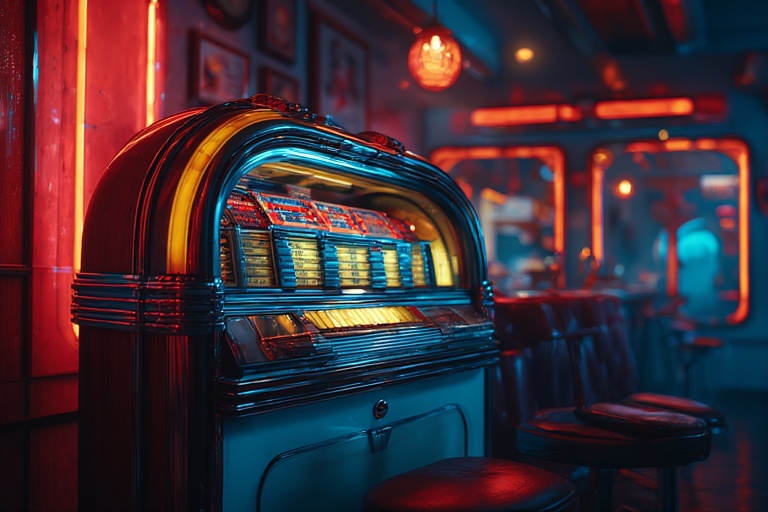
From Vinyl to Virtual
There’s a familiar ritual that anyone who’s ever fed a jukebox can recall: the clink of a coin dropping, the mechanical whir of gears, the pause before the first note bursts through the speaker. It’s not just about the music—it’s about that feeling of ownership. For a few minutes, the room belongs to you.
The jukebox has always been more than a machine. It’s a mirror of its time—a reflection of the era’s technology, musical trends, and social atmosphere. From its humble mechanical beginnings to today’s digital, app-connected marvels, the jukebox has evolved in step with society’s changing relationship to music.
What began as a nickel-fed novelty became a cultural icon, survived the rise of home entertainment, adapted to the digital age, and continues to thrive as a symbol of shared musical experience.
This is the story of the jukebox—from vinyl to virtual, from analog heartbeats to digital streams.
🎼 The Birth of the Coin-Operated Sound Machine (1890s–1930s)
The jukebox’s origins trace back to the late 19th century, when recorded sound itself was still a marvel. In 1889, Louis Glass and William S. Arnold unveiled a coin-operated phonograph at San Francisco’s Palais Royale Saloon. Patrons dropped in a nickel and listened to a short wax-cylinder recording through one of four listening tubes.
Though primitive, it represented something profound: a democratic experience of music. Anyone—regardless of wealth or status—could choose what to hear, when to hear it, and share it publicly.
By the 1920s and 1930s, as records replaced cylinders, the jukebox began to resemble the entertainment centerpiece we know today. Companies like Wurlitzer, Seeburg, and Rock-Ola saw opportunity in combining mechanical engineering with musical artistry.
These early machines weren’t just functional—they were designed to dazzle. With polished chrome, glowing lights, and intricate mechanisms visible through glass, jukeboxes became kinetic sculptures that drew people in.
The Great Depression could have killed them—but instead, it made them thrive. When people couldn’t afford orchestras or nightclubs, a few coins in a jukebox brought the joy of live music into every corner bar and diner. The jukebox became a little slice of hope—a machine that made hard times bearable, one song at a time.
💿 The Vinyl Boom: Soundtracking America’s Postwar Dream (1940s–1960s)
After World War II, America changed—and so did the jukebox. The 45 RPM vinyl record arrived in 1949, offering higher fidelity, lower cost, and compact size. Jukeboxes could now hold more songs and play them with better sound quality than ever before.
The postwar boom brought diners, soda fountains, and drive-ins—places where jukeboxes became cultural landmarks. With their glowing neon, curved glass, and rhythmic animation, they were as much a part of the décor as the checkered floors and chrome stools.
Wurlitzer’s 1015 model, nicknamed the “Bubbler,” became an icon of 1940s design and remains one of the most recognizable jukeboxes ever built. Its colorful, fluid columns and Art Deco elegance captured the optimism of a new era.
The 1950s and 1960s saw the jukebox reach its zenith. This was the age of Elvis Presley, Chuck Berry, Buddy Holly, and The Supremes. The jukebox became a vessel of rebellion and romance—a machine where teenagers discovered rock ‘n’ roll, country, soul, and doo-wop.
In small-town America, jukeboxes were the great equalizers. They brought the same music to diners in Kansas as to bars in New York. For the first time, popular taste was shaped not by radio programmers, but by ordinary people dropping quarters and making their voices heard through song selection.
The jukebox had become the people’s DJ.
⚙️ The Electronic Age: From Mechanical Marvels to Microchips (1970s–1990s)
As the 1970s dawned, the jukebox world began to hum with a different kind of energy. Microprocessors, LEDs, and circuit boards replaced many of the clunky mechanical parts that had defined earlier designs.
Companies like Rowe International and Seeburg began integrating electronic song selection systems, which made it easier to browse larger catalogs without flipping through thick pages of printed titles.
At the same time, musical formats were evolving fast. Vinyl records, though beloved, began to share space with cassette tapes—and later with compact discs (CDs). The CD jukebox of the 1980s was a marvel of precision, capable of holding hundreds of albums with high-quality stereo sound.
Machines like the Rowe CD-100 and NSM Prestige ushered in a new era. With better amplification, programmable playlists, and flashing digital displays, these jukeboxes turned every bar into a concert hall.
Still, the cultural context was shifting. The rise of the home stereo system, boombox, and personal cassette player meant people had more control over their own listening experiences. The jukebox was no longer the gatekeeper of popular music—it had to compete for attention.
In response, manufacturers began emphasizing style, sound quality, and innovation. Some jukeboxes added video displays, while others experimented with karaoke functions or even connected to early networked databases.
The mechanical soul of the jukebox was transforming into an electronic brain.
💻 The Digital Revolution: From CDs to Cloud (2000s–2010s)
Then came the internet—and with it, another seismic shift. As MP3s and streaming transformed how music was distributed and consumed, the jukebox industry faced both an existential threat and a golden opportunity.
Enter digital jukeboxes. Companies like TouchTunes, AMI Entertainment, and Sound Leisure redefined the category by replacing physical media with digital storage and, eventually, cloud-based streaming.
Instead of 100 discs, a jukebox could now access millions of tracks—any genre, any decade, instantly. Patrons could browse vast libraries using a touchscreen interface, customize playlists, and even pay extra to skip the line or play a specific song next.
The experience became interactive and social. TouchTunes introduced mobile apps that let users choose songs from their phones, pay remotely, and see what was playing at other venues. Jukeboxes began connecting to social media, letting users share their song choices or dedicate tracks to friends.
For bar owners, digital jukeboxes provided not only music but data—analytics about listening trends, demographics, and time-of-day patterns. Music became measurable, monetized, and infinitely customizable.
It wasn’t just a box full of records anymore. It was a networked entertainment platform—one part DJ, one part marketing tool, one part digital jukebox jukebox symphony of data.
📱 The Modern Jukebox: A Social Hub in the Age of Streaming
Today’s jukeboxes are masterpieces of design and technology. Sleek, connected, and customizable, they blend nostalgia with convenience.
Most models now feature high-definition displays, advanced sound systems, and touchscreen interfaces that rival smartphones in smoothness. Patrons can browse by mood, genre, or artist—some even integrate with Spotify or Apple Music for personalized recommendations.
Artificial intelligence and machine learning are beginning to shape playlists automatically based on crowd behavior. Imagine a jukebox that senses when the energy in a bar dips and queues up an upbeat track—or one that adjusts its lighting and soundscape to match the time of day.
The jukebox has also retained its emotional core. Even in a world where everyone carries private playlists in their pocket, there’s something special about choosing a song in public. The collective cheer when the right tune hits—the tapping feet, the raised glasses, the nods of recognition—those are moments no streaming algorithm can replicate.
🔮 The Future: Voice, AI, and Beyond
So, where does the jukebox go next?
The future likely lies in deeper integration with AI and smart environments. Voice-activated song requests, personalized recommendations based on local trends, and augmented-reality interfaces could redefine the experience once again.
We might soon see jukeboxes that sync with venue lighting, respond to crowd noise levels, or display visualizations of the music in real time. Some concepts even explore virtual jukeboxes in metaverse-style social spaces—digital recreations of bars and diners where users can drop virtual coins and hear real music together from across the world.
Yet despite all this innovation, the core idea remains the same: the jukebox is about participation. It’s about turning passive listening into shared storytelling. Every coin, every tap, every song played is a statement—“This is who I am. This is what I want the world to hear.”
❤️ Conclusion: The Soul of the Jukebox Lives On
From dusty corner taverns to sleek urban lounges, from spinning 78s to streaming 320 kbps MP3s, the jukebox has outlasted nearly every music format that ever existed.
Why? Because it’s more than a device—it’s a ritual. It’s the bridge between music and memory, between individual taste and collective experience. Whether you’re playing Sinatra on a glowing Wurlitzer or Drake on a digital touchscreen, you’re participating in a century-old tradition of musical democracy.
In the end, the jukebox’s magic isn’t in the gears or the glass or the cloud connection—it’s in the moment when a roomful of strangers becomes united by a single song.
From vinyl to virtual, the jukebox continues to sing the same tune: music is meant to be shared.