
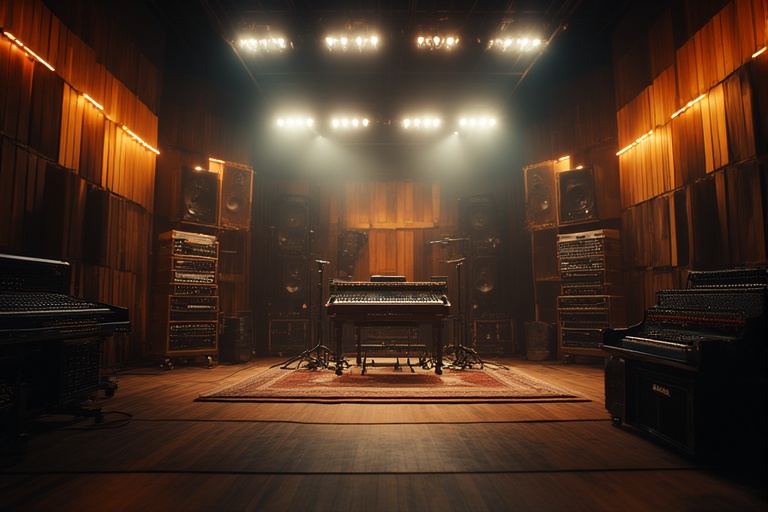
Why Acoustics Still Matter
In an age where digital tools can replicate nearly any sound imaginable, it might seem that the importance of physical space—the shape, texture, and resonance of a recording room—has diminished. After all, plugins can simulate concert halls, vocal booths, and even the reverberant glow of legendary studios. Yet, for those who have stood in a well-designed recording space, strummed a guitar, or sung into the room’s natural response, there’s no substitute for the real thing. The magic of room sound remains one of the most powerful, elusive, and emotional aspects of music production.
The Room as an Instrument
Every sound we hear is shaped not only by the source but also by the space it inhabits. A grand piano sounds vastly different in a cathedral than it does in a bedroom. Drums recorded in a tight, deadened room feel punchy and intimate; the same performance in a large, reflective chamber becomes thunderous and cinematic. The room acts as a silent collaborator—a partner in performance.
In well-designed studios, acousticians and architects work together to sculpt these responses. They balance absorption, diffusion, and reflection so that sound waves behave predictably, without coloring the mix in unpleasant ways. More than a technical consideration, this is an artistic choice. Legendary rooms like Abbey Road’s Studio Two, Sunset Sound, and Ocean Way are celebrated not only for their gear but for their distinct sonic personalities. Musicians often say they can “hear the room” in certain classic recordings—and they mean it.
The Psychology of Space
The impact of acoustics isn’t only about frequency response or reverb time—it’s also deeply psychological. Musicians perform differently when they feel enveloped by the sound of the room. A singer in a well-tuned space hears their voice come back naturally, giving confidence and emotional feedback that can’t be faked by headphones alone.
Similarly, drummers respond to the “air” around their kit; guitarists linger on sustained notes because of how they bloom in the space. The right acoustic environment encourages creativity, spontaneity, and emotional connection. A sterile or overly dead room, on the other hand, can stifle expression, making the performance feel clinical.
Imperfection as Character
Part of the allure of real room sound lies in its imperfections. No two rooms sound exactly alike. Subtle resonances, asymmetrical reflections, and even the materials of the walls and floors contribute to a unique fingerprint. Think of the echo in Sun Studio, where early rock ‘n’ roll took shape, or the ambient shimmer of Columbia’s 30th Street Studio, where Miles Davis recorded Kind of Blue. Those acoustic quirks weren’t problems to be fixed—they were defining traits.
In modern production, where clarity and control often take precedence, there’s a growing movement to re-embrace these idiosyncrasies. Producers are rediscovering the emotional authenticity that comes from real ambience. Room microphones, once an afterthought, are now prized for capturing the organic energy of a session.
Acoustics in the Age of the Home Studio
The democratization of recording technology has empowered countless musicians to create professional-quality music at home. However, one of the most overlooked aspects of this revolution is acoustics. A $1,000 microphone can sound like a $50 one in a poorly treated room. Even with the best plugins, the source recording still reflects the acoustic truth of the space it was made in.
Fortunately, achieving good room sound doesn’t require a million-dollar build. Simple, thoughtful treatment—bass traps, absorptive panels, diffusers, and proper placement—can transform a home studio from “boxy” to “balanced.” The key is not to eliminate reflections entirely but to manage them in a way that complements the kind of music being made.
Creative Uses of Space
Some producers go even further, using room sound as a deliberate creative tool. Recording in stairwells, churches, abandoned buildings, or natural environments can produce textures that no digital effect can replicate. The rise of “found acoustics” and location recording underscores a broader truth: spaces have emotional identities.
For example, the haunting spaciousness of Bon Iver’s For Emma, Forever Ago came partly from recording in a remote cabin. Likewise, U2’s The Unforgettable Fire gained its distinctive atmosphere from the reverberant rooms of Slane Castle. These choices weren’t accidents—they were creative decisions that bound the music to its environment.
The Future of Room Sound
Ironically, as virtual studio technology becomes more sophisticated, it also reminds us of what we’re missing. Artificial reverbs and convolution algorithms—some of which sample real rooms in exquisite detail—are attempts to recreate the natural complexity of acoustic spaces. Dolby Atmos and immersive formats extend this idea, placing listeners inside a virtual environment. But even these innovations are rooted in the timeless appeal of spatial realism.
The next frontier may not be choosing between physical and digital spaces but integrating them. Hybrid studios that combine carefully treated rooms with advanced spatial processing will define the sound of the next decade. Artists will continue to chase not perfection, but presence—the feeling that the music lives and breathes within a real, resonant world.
Acoustics is the invisible art form that shapes how we feel sound. While technology can simulate and manipulate space in extraordinary ways, the creative power of a well-designed room remains irreplaceable. The best studios aren’t just places to record—they’re instruments in their own right, amplifying emotion, performance, and connection.